 Add to Chrome
 Add to Firefox
 Add to Edge
From Scene to Object: Text-Guided Dual-Gaze Prediction
Apr 22, 2026
Interpretable driver attention prediction is crucial for human-like autonomous driving. However, existing datasets provide only scene-level global gaze rather than fine-grained object-level annotations, inherently failing to support text-grounded cognitive modeling. Consequently, while Vision-Language Models (VLMs) hold great potential for semantic reasoning, this critical data limitations leads to severe text-vision decoupling and visual-bias hallucinations. To break this bottleneck and achieve precise object-level attention prediction, this paper proposes a novel dual-branch gaze prediction framework, establishing a complete paradigm from data construction to model architecture. First, we construct G-W3DA, a object-level driver attention dataset. By integrating a multimodal large language model with the Segment Anything Model 3 (SAM3), we decouple macroscopic heatmaps into object-level masks under rigorous cross-validation, fundamentally eliminating annotation hallucinations. Building upon this high-quality data foundation, we propose the DualGaze-VLM architecture. This architecture extracts the hidden states of semantic queries and dynamically modulates visual features via a Condition-Aware SE-Gate, achieving intent-driven precise spatial anchoring. Extensive experiments on the W3DA benchmark demonstrate that DualGaze-VLM consistently surpasses existing state-of-the-art (SOTA) models in spatial alignment metrics, notably achieving up to a 17.8% improvement in Similarity (SIM) under safety-critical scenarios. Furthermore, a visual Turing test reveals that the attention heatmaps generated by DualGaze-VLM are perceived as authentic by 88.22% of human evaluators, proving its capability to generate rational cognitive priors.

DSAINet: An Efficient Dual-Scale Attentive Interaction Network for General EEG Decoding
Apr 20, 2026In real-world applications of noninvasive electroencephalography (EEG), specialized decoders often show limited generalizability across diverse tasks under subject-independent settings. One central challenge is that task-relevant EEG signals often follow different temporal organization patterns across tasks, while many existing methods rely on task-tailored architectural designs that introduce task-specific temporal inductive biases. This mismatch makes it difficult to adapt temporal modeling across tasks without changing the model configuration. To address these challenges, we propose DSAINet, an efficient dual-scale attentive interaction network for general EEG decoding. Specifically, DSAINet constructs shared spatiotemporal token representations from raw EEG signals and models diverse temporal dynamics through parallel convolutional branches at fine and coarse scales. The resulting representations are then adaptively refined by intra-branch attention to emphasize salient scale-specific patterns and by inter-branch attention to integrate task-relevant features across scales, followed by adaptive token aggregation to yield a compact representation for prediction. Extensive experiments on five downstream EEG decoding tasks across ten public datasets show that DSAINet consistently outperforms 13 representative baselines under strict subject-independent evaluation. Notably, this performance is achieved using the same architecture hyperparameters across datasets. Moreover, DSAINet achieves a favorable accuracy-efficiency trade-off with only about 77K trainable parameters and provides interpretable neurophysiological insights. The code is publicly available at https://github.com/zy0929/DSAINet.
ScoRe-Flow: Complete Distributional Control via Score-Based Reinforcement Learning for Flow Matching
Apr 13, 2026Flow Matching (FM) policies have emerged as an efficient backbone for robotic control, offering fast and expressive action generation that underpins recent large-scale embodied AI systems. However, FM policies trained via imitation learning inherit the limitations of demonstration data; surpassing suboptimal behaviors requires reinforcement learning (RL) fine-tuning. Recent methods convert deterministic flows into stochastic differential equations (SDEs) with learnable noise injection, enabling exploration and tractable likelihoods, but such noise-only control can compromise training efficiency when demonstrations already provide strong priors. We observe that modulating the drift via the score function, i.e., the gradient of log-density, steers exploration toward high-probability regions, improving stability. The score admits a closed-form expression from the velocity field, requiring no auxiliary networks. Based on this, we propose ScoRe-Flow, a score-based RL fine-tuning method that combines drift modulation with learned variance prediction to achieve decoupled control over the mean and variance of stochastic transitions. Experiments demonstrate that ScoRe-Flow achieves 2.4x faster convergence than flow-based SOTA on D4RL locomotion tasks and up to 5.4% higher success rates on Robomimic and Franka Kitchen manipulation tasks.
Semantic-aware Adversarial Fine-tuning for CLIP
Feb 12, 2026Recent studies have shown that CLIP model's adversarial robustness in zero-shot classification tasks can be enhanced by adversarially fine-tuning its image encoder with adversarial examples (AEs), which are generated by minimizing the cosine similarity between images and a hand-crafted template (e.g., ''A photo of a {label}''). However, it has been shown that the cosine similarity between a single image and a single hand-crafted template is insufficient to measure the similarity for image-text pairs. Building on this, in this paper, we find that the AEs generated using cosine similarity may fail to fool CLIP when the similarity metric is replaced with semantically enriched alternatives, making the image encoder fine-tuned with these AEs less robust. To overcome this issue, we first propose a semantic-ensemble attack to generate semantic-aware AEs by minimizing the average similarity between the original image and an ensemble of refined textual descriptions. These descriptions are initially generated by a foundation model to capture core semantic features beyond hand-crafted templates and are then refined to reduce hallucinations. To this end, we propose Semantic-aware Adversarial Fine-Tuning (SAFT), which fine-tunes CLIP's image encoder with semantic-aware AEs. Extensive experiments show that SAFT outperforms current methods, achieving substantial improvements in zero-shot adversarial robustness across 16 datasets. Our code is available at: https://github.com/tmlr-group/SAFT.
STEP: Warm-Started Visuomotor Policies with Spatiotemporal Consistency Prediction
Feb 09, 2026Diffusion policies have recently emerged as a powerful paradigm for visuomotor control in robotic manipulation due to their ability to model the distribution of action sequences and capture multimodality. However, iterative denoising leads to substantial inference latency, limiting control frequency in real-time closed-loop systems. Existing acceleration methods either reduce sampling steps, bypass diffusion through direct prediction, or reuse past actions, but often struggle to jointly preserve action quality and achieve consistently low latency. In this work, we propose STEP, a lightweight spatiotemporal consistency prediction mechanism to construct high-quality warm-start actions that are both distributionally close to the target action and temporally consistent, without compromising the generative capability of the original diffusion policy. Then, we propose a velocity-aware perturbation injection mechanism that adaptively modulates actuation excitation based on temporal action variation to prevent execution stall especially for real-world tasks. We further provide a theoretical analysis showing that the proposed prediction induces a locally contractive mapping, ensuring convergence of action errors during diffusion refinement. We conduct extensive evaluations on nine simulated benchmarks and two real-world tasks. Notably, STEP with 2 steps can achieve an average 21.6% and 27.5% higher success rate than BRIDGER and DDIM on the RoboMimic benchmark and real-world tasks, respectively. These results demonstrate that STEP consistently advances the Pareto frontier of inference latency and success rate over existing methods.
Training-Driven Representational Geometry Modularization Predicts Brain Alignment in Language Models
Feb 07, 2026How large language models (LLMs) align with the neural representation and computation of human language is a central question in cognitive science. Using representational geometry as a mechanistic lens, we addressed this by tracking entropy, curvature, and fMRI encoding scores throughout Pythia (70M-1B) training. We identified a geometric modularization where layers self-organize into stable low- and high-complexity clusters. The low-complexity module, characterized by reduced entropy and curvature, consistently better predicted human language network activity. This alignment followed heterogeneous spatial-temporal trajectories: rapid and stable in temporal regions (AntTemp, PostTemp), but delayed and dynamic in frontal areas (IFG, IFGorb). Crucially, reduced curvature remained a robust predictor of model-brain alignment even after controlling for training progress, an effect that strengthened with model scale. These results links training-driven geometric reorganization to temporal-frontal functional specialization, suggesting that representational smoothing facilitates neural-like linguistic processing.
Signal-Adaptive Trust Regions for Gradient-Free Optimization of Recurrent Spiking Neural Networks
Jan 29, 2026Recurrent spiking neural networks (RSNNs) are a promising substrate for energy-efficient control policies, but training them for high-dimensional, long-horizon reinforcement learning remains challenging. Population-based, gradient-free optimization circumvents backpropagation through non-differentiable spike dynamics by estimating gradients. However, with finite populations, high variance of these estimates can induce harmful and overly aggressive update steps. Inspired by trust-region methods in reinforcement learning that constrain policy updates in distribution space, we propose \textbf{Signal-Adaptive Trust Regions (SATR)}, a distributional update rule that constrains relative change by bounding KL divergence normalized by an estimated signal energy. SATR automatically expands the trust region under strong signals and contracts it when updates are noise-dominated. We instantiate SATR for Bernoulli connectivity distributions, which have shown strong empirical performance for RSNN optimization. Across a suite of high-dimensional continuous-control benchmarks, SATR improves stability under limited populations and reaches competitive returns against strong baselines including PPO-LSTM. In addition, to make SATR practical at scale, we introduce a bitset implementation for binary spiking and binary weights, substantially reducing wall-clock training time and enabling fast RSNN policy search.
A Unified Variational Imputation Framework for Electric Vehicle Charging Data Using Retrieval-Augmented Language Model
Jan 20, 2026The reliability of data-driven applications in electric vehicle (EV) infrastructure, such as charging demand forecasting, hinges on the availability of complete, high-quality charging data. However, real-world EV datasets are often plagued by missing records, and existing imputation methods are ill-equipped for the complex, multimodal context of charging data, often relying on a restrictive one-model-per-station paradigm that ignores valuable inter-station correlations. To address these gaps, we develop a novel PRobabilistic variational imputation framework that leverages the power of large lAnguage models and retrIeval-augmented Memory (PRAIM). PRAIM employs a pre-trained language model to encode heterogeneous data, spanning time-series demand, calendar features, and geospatial context, into a unified, semantically rich representation. This is dynamically fortified by retrieval-augmented memory that retrieves relevant examples from the entire charging network, enabling a single, unified imputation model empowered by variational neural architecture to overcome data sparsity. Extensive experiments on four public datasets demonstrate that PRAIM significantly outperforms established baselines in both imputation accuracy and its ability to preserve the original data's statistical distribution, leading to substantial improvements in downstream forecasting performance.
* 15 pages
MMReID-Bench: Unleashing the Power of MLLMs for Effective and Versatile Person Re-identification
Aug 09, 2025Person re-identification (ReID) aims to retrieve the images of an interested person in the gallery images, with wide applications in medical rehabilitation, abnormal behavior detection, and public security. However, traditional person ReID models suffer from uni-modal capability, leading to poor generalization ability in multi-modal data, such as RGB, thermal, infrared, sketch images, textual descriptions, etc. Recently, the emergence of multi-modal large language models (MLLMs) shows a promising avenue for addressing this problem. Despite this potential, existing methods merely regard MLLMs as feature extractors or caption generators, which do not fully unleash their reasoning, instruction-following, and cross-modal understanding capabilities. To bridge this gap, we introduce MMReID-Bench, the first multi-task multi-modal benchmark specifically designed for person ReID. The MMReID-Bench includes 20,710 multi-modal queries and gallery images covering 10 different person ReID tasks. Comprehensive experiments demonstrate the remarkable capabilities of MLLMs in delivering effective and versatile person ReID. Nevertheless, they also have limitations in handling a few modalities, particularly thermal and infrared data. We hope MMReID-Bench can facilitate the community to develop more robust and generalizable multimodal foundation models for person ReID.
OBIFormer: A Fast Attentive Denoising Framework for Oracle Bone Inscriptions
Apr 18, 2025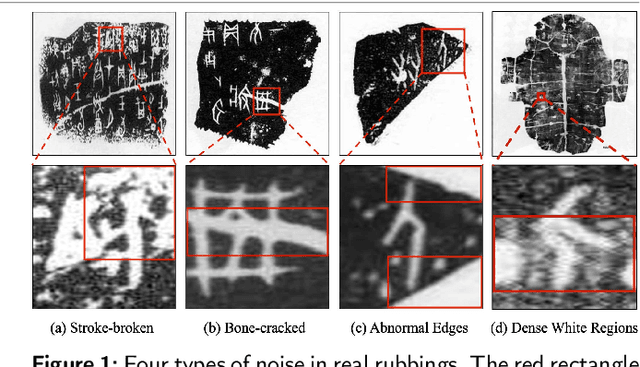
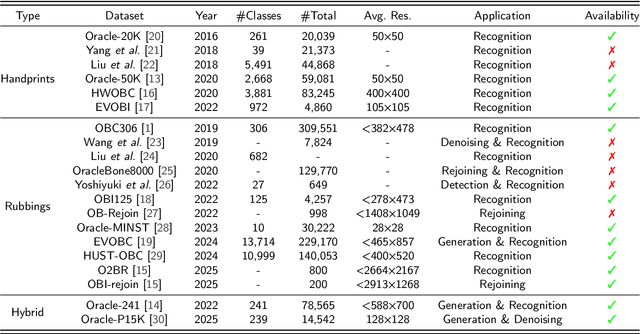
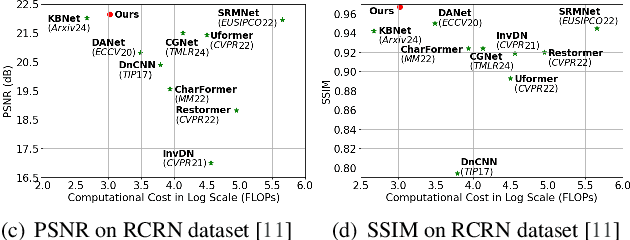
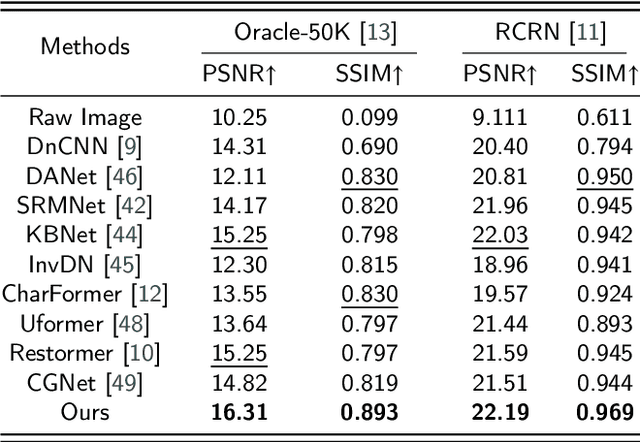
Oracle bone inscriptions (OBIs) are the earliest known form of Chinese characters and serve as a valuable resource for research in anthropology and archaeology. However, most excavated fragments are severely degraded due to thousands of years of natural weathering, corrosion, and man-made destruction, making automatic OBI recognition extremely challenging. Previous methods either focus on pixel-level information or utilize vanilla transformers for glyph-based OBI denoising, which leads to tremendous computational overhead. Therefore, this paper proposes a fast attentive denoising framework for oracle bone inscriptions, i.e., OBIFormer. It leverages channel-wise self-attention, glyph extraction, and selective kernel feature fusion to reconstruct denoised images precisely while being computationally efficient. Our OBIFormer achieves state-of-the-art denoising performance for PSNR and SSIM metrics on synthetic and original OBI datasets. Furthermore, comprehensive experiments on a real oracle dataset demonstrate the great potential of our OBIFormer in assisting automatic OBI recognition. The code will be made available at https://github.com/LJHolyGround/OBIFormer.